Michigan PSC Releases Recommendations Meant to Lower Energy Costs for Families
To: Interested Parties
From: Evergreen Action Communications Director Seth Nelson
Date: January 15, 2026
Re: The Lie at the Heart of Trump’s Energy Agenda: One Year of Trump’s Energy Price Hikes
Tuesday marks one year since Donald Trump returned to office, and one year since the clock started on his campaign promise to cut energy prices in half for American families.
On the campaign trail, Trump promised voters he would ”cut […] energy and electricity prices in half […] within 12 months of taking the oath of office,” insisting it wasn’t “going to be hard.” He repeated that promise dozens of times.
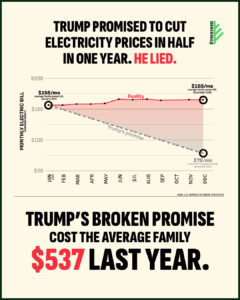
One year later, the gap between Trump’s promise and reality is staggering. Based on our analysis of U.S. Bureau of Labor Statistics data on average residential electricity prices, the average household paid $537 more (see footnote for methodology) for electricity in 2025 than it would have if Trump had delivered on his promise to cut prices in half. Instead of falling by 50 percent, electricity prices are up 7.4 percent year over year, nearly three times the rate of economy-wide inflation, and 115% higher than they would be under Trump’s promised price cut.
But let’s be clear: this wasn’t a failure to deliver. When faced with a choice between actions that could lower costs for working families or enriching himself and his wealthy allies, Trump chose the latter. Every time. That choice defines his presidency.
Nowhere is that clearer than in his energy agenda, which is built on a simple principle: govern for Big Oil and his fossil fuel allies, not for Americans struggling to keep the lights on. And Americans are feeling it. A recent Heatmap poll found that more than half of the country is already feeling financial pain from rising electricity bills, while a Washington Post-ABC News-Ipsos poll found that a majority of Americans report spending more on utilities than a year ago—and they blame Trump.
Americans know exactly who’s responsible, but unfortunately for them, Trump shows no signs of slowing down his crusade to make them pay more so his fossil fuel allies can rake in maximum profits.
Trump Declared War on Cheap, Clean Energy When America Needed It Most
From his very first day back in office, Trump has systematically sabotaged clean energy, the fastest-to-build and cheapest way to meet rising demand and keep electricity bills down.
Before Trump took the oath of office, clean energy was booming. In 2024, 93 percent of all new power capacity added in the U.S. came from clean energy. Then Trump was sworn in and immediately reversed course, launching an all-out assault on wind and solar.
Over the past year, his administration has frozen or cancelled billions in already awarded clean energy grants and loans, moved to revoke approvals for already permitted projects, killed clean energy tax credits with the help of his Republican allies in Congress, and imposed a political review process that has placed new wind and solar projects in bureaucratic limbo.
It was chaos by design: uncertainty for developers, skittish investors, and canceled projects that could have produced enough electricity to power 13 million homes. Meanwhile, the average American family’s annual electricity costs are more than $100 higher than they were at the start of last year.
Trump isn’t hiding his motive. “My goal is [to] not let any windmill be built,” he told a room full of Big Oil executives last week. He has turned that goal into an all-of-government effort to block and delay, including ordering multiple fully permitted offshore wind projects to halt construction last month.
The courts are already blocking Trump’s nakedly political attempt to kill the industry, but delay is the point. The longer projects are stalled, the more expensive they become—and the more likely they are to be abandoned. As a result, the U.S. is expected to add only half as much new renewable power by 2030 as experts projected before Trump took office.
The consequences are straightforward: less cheap, clean energy as demand surges—and higher bills for everyone.
Trump Chose Polluter Profits Over Lower Energy Prices
Trump’s energy agenda was never about affordability. It was always about fossil fuel profits.
During his campaign, Trump struck a clear quid pro quo with Big Oil: $1 billion in campaign cash in exchange for delivering on its policy wish list. He has certainly followed through—moving to gut environmental protections, including air pollution standards, handing out $18 billion in new tax breaks, and wiping out federal investments to sabotage their clean energy competition.
There’s no clearer example of who Trump’s energy agenda is really for than his efforts to prop up coal. There’s no coal revival waiting around the corner, yet Trump has forced Americans to bail out the dying industry anyway: dumping over half a billion taxpayer dollars to keep the industry on life support and ordering uneconomic plants to stay online long past their retirement dates. All of us are footing the bill.
In Michigan, retiring one coal plant was projected to save ratepayers roughly $600 million through 2040. Instead, Trump’s repeated interventions to keep it running have already saddled families with at least $113 million in extra costs in just eight months since it was supposed to shut down. Keeping just one coal plant open in Michigan costs local families $615,000 a day—and Trump is forcing these extra costs on communities across the country. Americans are paying more to burn the dirtiest, most expensive fuel on the grid so a few coal barons can keep collecting profits.
Gas follows a similar pattern. On his first day in office, Trump lifted restrictions on new liquefied “natural” gas (LNG) export approvals and turned American gas into a bargaining chip for his trade and anti-climate demands abroad—pressuring European allies to commit to purchasing $750 billion worth of U.S. gas. That strategy comes with a direct cost at home. As gas exports rise, American households are increasingly exposed to volatile global prices, which are driving up domestic heating and electricity bills. Through September of last year alone, American households paid at least $12 billion more on their gas bills compared to the previous year—about $124 extra per household. Meanwhile, LNG exporters are raking in record profits.
Trump’s Energy Agenda Was a Lie From the Start
Recently, a Trump spokesperson succinctly and perfectly summed up his energy agenda: “High energy prices are a choice.”
Trump is sabotaging cheap, clean energy while propping up the most expensive fuels on the grid at the exact moment power-hungry data centers and more frequent, more intense extreme weather are driving demand higher. Utilities are already passing those costs on to households. Since Trump took office, utilities have requested more than $85 billion in rate hikes, affecting at least 108 million electric customers and 49 million gas customers—and more increases are on the way.
From the start, Trump intended to govern for Big Oil and his fossil fuel allies, not for working families. The agenda he sold to the American people, one built on a promise to cut energy prices in half, was a lie from the start.
For more information or to speak with a policy expert, please contact Evergreen Action Communications Director Seth Nelson at seth@evergreenaction.com.
Evergreen has been tracking all the ways Trump is hiking energy prices and making life less affordable for Americans. You can read the latest breakdown here and find a running analysis of prior actions here.
###
Methodology Footnote: This estimate uses Bureau of Labor Statistics (BLS) data on average residential electricity prices and U.S. Energy Information Administration data on average household electricity use. We calculated the average monthly electricity bill paid by a U.S. household in 2025 by multiplying each month’s average price per kilowatt-hour by average monthly household consumption (875 kWh), then summing those monthly costs across the year. We then calculated a hypothetical scenario in which electricity prices declined linearly from their January 2025 level to 50 percent of that level by December 2025, applying the same consumption assumption. The difference between these two totals shows that the average household paid $537.25 more for electricity in 2025 than it would have under the promised price-cut scenario.
Related News
The Courts Deal Another Blow to Trump’s War on Wind
The Courts Deal Another Blow to Trump’s War on Wind
ICYMI: How PJM’s Clean Energy Delays Are Costing Customers Amid Extreme Heat
ICYMI: How PJM’s Clean Energy Delays Are Costing Customers Amid Extreme Heat
Michigan Voters Just Put Energy Affordability on November’s Ballot
Michigan Voters Just Put Energy Affordability on November’s Ballot
Related News
Michigan PSC Releases Recommendations Meant to Lower Energy Costs for Families
Michigan PSC Releases Recommendations Meant to Lower Energy Costs for Families
The Courts Deal Another Blow to Trump’s War on Wind
The Courts Deal Another Blow to Trump’s War on Wind
ICYMI: How PJM’s Clean Energy Delays Are Costing Customers Amid Extreme Heat
ICYMI: How PJM’s Clean Energy Delays Are Costing Customers Amid Extreme Heat
Michigan Voters Just Put Energy Affordability on November’s Ballot