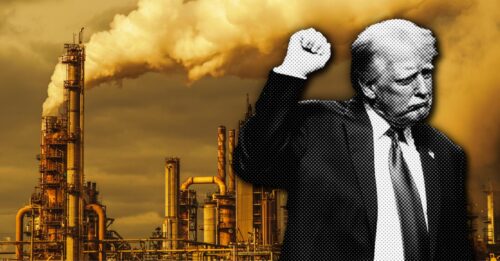
Trump’s Energy Price Hikes Are on the Ballot, and Voters Are Ready to Pull the Plug
To: Interested Parties
From: Evergreen Action Communications Director Seth Nelson
Date: Monday, June 29, 2026
Re: Trump’s Energy Price Hike: One Big Beautiful Gift to Big Oil
Nearly one year ago, Donald Trump signed the One Big Beautiful Bill into law. The bill handed $18 billion in new tax breaks to fossil fuel companies while eliminating may of the clean energy tax credits that had become one of America’s most powerful tools for meeting surging electricity demand and keeping costs in check. Those credits—the ones driving new solar, wind, and battery storage projects across the country—will expire for most new projects on July 4, 2026, the law’s one-year anniversary.
The White House promised it would “drive down energy costs.” Here’s what it actually delivered:
According to federal government data, energy prices rose more than five times faster than the overall Consumer Price Index over the past year. Overall inflation hit a three-year high of 4.2% in May. Utilities have filed nearly $95.3 billion in rate hike requests since Trump took office—affecting nearly 112 million electric customers and more than 56 million natural gas customers. When asked whether he was concerned about rising costs on his watch, Trump declared: “I love the inflation.”
That answer tells you everything you need to know about who this agenda was built for. Trump’s reckless, illegal war in Iran sent gasoline prices soaring, and households have now spent nearly $500 more at the pump since the bombing began—over $64 billion in total. Oil and gas companies pocketed more than $30 million every hour in windfall profits in the war’s first month. Giants like BP saw profits more than double as global oil prices surged, while Big Oil executives raked in $1.4 billion selling stock while the U.S. was bombing Iran—including Chevron’s CEO, who pocketed $104 million.
The actions documented here are not a series of unrelated policy decisions. They form a coherent agenda. Trump signed a law taking powerful investments off the table that were cheaply and rapidly expanding clean energy on the grid and lowering bills while handing billions in new subsidies to the industry making those bills higher. He’s known for years that launching a major attack on Iran would risk the closure of the Strait of Hormuz—and send gas prices soaring—and his illegal war made his fossil fuel donors even richer. He’s propping up dirty, expensive coal plants that nobody needs and that families are paying for, blocking the wind and solar projects that could hold bills down, and paying companies billions in taxpayer money to abandon cheaper clean energy.
Every piece of it is a policy choice—made by a president who governs for his fossil fuel donors. Not for the working families paying for it at the pump and on their monthly bills. Below is an updated timeline of Trump’s latest actions raising energy prices since our last update:
Trump’s Energy Price Hike: An Updated Timeline
June 17: Trump again lights taxpayer money on fire to kill wind energy and boost fossil fuels
Action: Trump’s Department of the Interior (DOI) announced yet another deal paying an energy company to surrender its offshore wind leases—this time $765 million to Invenergy. In total, the Trump administration has paid nearly $2.7 billion in taxpayer dollars to kill offshore wind projects, under terms requiring companies to redirect money to fossil fuels instead.
Impact: While the rest of the world races to embrace offshore wind, the industry is collapsing in the U.S.—and Americans are footing the bill. It’s not hard to see why companies keep taking these deals. Developers who don’t already have completed offshore wind projects have faced months of illegal delays, dishonest legal arguments, and an administration determined to kill them by any available means. “That level of volatility is extreme when it comes to any infrastructure sector,” a Global Wind Energy Council leader told Canary Media. And it has a “chilling effect on the offshore wind industry as a whole.” The result: Americans pay twice for Trump’s corruption. First in the billions he’s lighting on fire to kill cheap wind power. Then again in the higher electricity bills they’ll face because that energy never gets built.
June 17: Trump administration files appeal, continues to defy court injunction barring political review of solar and wind projects
Action: Rather than comply with a federal court injunction barring the Interior Secretary Doug Burgum from personally bottlenecking solar and wind projects on public lands, the Trump administration filed an appeal and continues to block renewable energy permitting even as courts have rejected its authority to do so.
Impact: The court granted the injunction after finding that Burgum’s scheme to personally review the projects was likely illegal and causing irreparable harm to solar and wind developers. Democratic Senate negotiators have warned they won’t support bipartisan permitting reform unless the administration follows the law—a condition Burgum has chosen to ignore. Every month spent flouting the law is another month of lost energy generation that could have helped slow rising bills.
The timing is no accident. Clean energy tax credits expire for most new projects on July 4—a direct consequence of Trump’s “One Big Beautiful Bill.” The playbook writes itself: eliminate one of our most powerful tools for meeting rising demand and driving down electricity costs; give developers one year to qualify before the credits disappear; impose a “nearly complete moratorium” on permitting the projects that would have qualified—legal consequences be damned; and run out the clock. Trump’s energy price hike is not an act of incompetence—it’s intentional governance on behalf of Big Oil and his fossil fuel allies so they can rake in maximum profits while millions of Americans struggle to keep the lights on.
June 4: Trump hands coal barons $700 million in taxpayer dollars to bail out an already dead and buried industry
Action: Trump’s Department of Energy (DOE) announced it will invoke the Defense Production Act and pour $700 million in taxpayer funding to build two uneconomic new coal plants and extend the lives of more than a dozen others—including restarting a shuttered plant in Maryland against the will of state voters.
Impact: Spending $700 million to bail out coal is like throwing a lifeline to a ship that has already sunk. The market rejected coal long ago as cheaper alternatives rendered it uncompetitive—and the gap keeps widening. Coal-generated power was 28 percent more expensive in 2024 than in 2021, costing plant owners $6.2 billion more to generate the same amount of electricity. It’s now cheaper to replace nearly the entire U.S. coal fleet with new local solar, wind, or storage than to keep running it. In his announcement, Trump claimed the investment will “bring down the price of energy and the cost of living.” It won’t, and he knows it. If lowering costs were actually the goal, he’d stop sabotaging the wind and solar that could deliver it faster and cheaper. Instead, he’s handing hundreds of millions in taxpayer money to the same coal barons who funded his campaign, leaving families with higher bills and dirtier air while doing nothing to address an affordability crisis his own policies created.
June 1: Trump’s DOE issues illegal guidance preventing households from using home rebates to replace gas appliances with efficient electric ones
Action: Trump’s DOE issued illegal guidance blocking households from using the Home Electrification and Appliances Rebate program to replace outdated gas appliances with more efficient electric alternatives. Congress created this program specifically to help working families make exactly that switch—and the administration’s reinterpretation invents a restriction Congress never wrote.
Impact: Make no mistake: this move is part of a coordinated strategy to boost fossil fuel profits at the expense of working families. Residential gas bills increased twice as fast as electricity bills and four times the rate of inflation in Trump’s first year—the result of utilities more than doubling their pipeline spending over the last decade because they earn a guaranteed profit on every pipe they lay. These rebates were one of the few tools available to help families who otherwise couldn’t afford to escape those rising costs. The administration’s guidance doesn’t just deny them that help—it actively locks them into dependence on more expensive gas, ensuring that utilities and fossil fuel companies keep a captive customer base. At the exact moment millions of families need relief from rising energy costs, Trump is disregarding the law to deny it to them—and keep them hooked on the product his donors profit from.
May 21: Trump again forces ratepayers to pay to keep an old Pennsylvania gas plant online despite it running less than one percent of the time—at a cost of $70 million annually
Action: Trump’s DOE once again extended its order directing Constellation Energy to keep two units at its Eddystone fossil fuel-fired plant in Pennsylvania running, overriding the plant’s planned retirement for the fourth time. PJM approved the retirement of both units back in December of 2023, finding the closure posed no reliability risk to the grid.
Impact: The two units Trump is forcing to stay open ran less than 1 percent of the time from 2020 to 2023—and the administration has yet to produce compelling evidence that anything has changed. In justifying an earlier extension, DOE pointed to the fact that the Eddystone units were called on during summer heatwaves as proof they were “critical to maintaining reliability.” What DOE left out is that there was no electricity shortage—PJM was actually exporting power to other regions during those same heatwaves. These units were scheduled to retire because they were old, too expensive to run, and unnecessary for grid reliability. Keeping them online costs an estimated $70 million a year—costs that are directly passed on to ratepayers despite providing no benefit to the grid.
May 18: Trump forces Michigan coal plant on life support to stay open—again—sticking ratepayers with the bill for an ‘emergency’ that doesn’t exist
Action: Trump’s DOE renewed its order forcing an uneconomical Michigan coal plant—slated to retire nearly a year ago—to keep operating. The administration is now forcing coal plants in Michigan, Indiana, Florida, Washington, and Colorado to remain open past their planned retirement dates.
Impact: Michigan Attorney General Dana Nessel, who argues the supposed emergency is a pretext for advancing the administration’s coal agenda and is challenging the order in federal court, put it plainly. “By arbitrarily declaring a false emergency, the Trump administration is forcing Michigan residents to foot the bill for an aging, expensive coal plant that was slated for responsible, cost-saving retirement,” she said. She’s right. Consumers Energy, the utility operating the Michigan plant, has racked up $180 million in costs since Trump began abusing his emergency authority, including additional expenses to bring staff back, catch up on deferred maintenance, and lock in new coal delivery contracts. Consumers Energy spent years carefully planning this plant’s retirement and securing cheaper resources to replace the power the plant provided. If the energy shortage emergency Trump keeps declaring were real, blocking wind and solar projects that could add electricity to the grid faster and at a lower cost than any coal plant he’s propping up would only make it worse. Make it make sense.
May 3: Pentagon grinds onshore wind development to a halt, weaponizing once-routine reviews required for approval, stalling more than 250 projects
Action: The Pentagon indefinitely suspended all routine national security reviews required for onshore wind approvals, invoking national security as a pretext to shut down permitting entirely. The freeze applies to projects at every stage: at least 30 that had already received verbal sign-offs and were awaiting only written confirmation, dozens in the middle of active negotiations, and some that wouldn’t have required Pentagon oversight at all. According to the American Clean Power Association, not a single onshore wind project undergoing Pentagon review has received what was a once-routine approval since August 2025.
Impact: More than 250 onshore wind projects are now stalled—projects that would generate enough electricity to power at least 20 million homes. A coalition of renewable energy groups has sued the Pentagon, arguing the halt is unlawful and is inflicting “catastrophic effects” on the U.S. wind industry. Wind is one of the cheapest, fastest ways to add new electricity capacity, undercutting new-build gas and coal on price. Every project stalled is new power the grid won’t have as demand surges, and a higher bill American families will pay for Trump’s ideological war on the energy that would have lowered them.
April 27: Trump pays two more companies to walk away from offshore wind leases
Action: Trump’s DOI announced that Bluepoint Wind and Golden State Wind would surrender their offshore wind leases in exchange for nearly $900 million in taxpayer money—the second round of buyouts in a little over a month, following a similar $1 billion deal with TotalEnergies. The pattern is clear: having racked up a string of court losses in his brazen, illegal attempts to shut down already-in-progress offshore wind projects, Trump has switched to a new, legally dubious strategy—paying off companies to kill them instead.
Impact: Seven states have already sued to stop the TotalEnergies deal, which the DOI called “historic.” Historic is one word for it. House Natural Resources Committee Ranking Member Jared Huffman has a different word for it: a “scam.” That’s an apt description of an arrangement where Trump uses taxpayer dollars to pay private companies to abandon clean energy, with the payout contingent on reinvesting in fossil fuels instead. Taken together, these deals have now killed projects that would have generated enough wind energy to power more than 3.4 million homes—1.3 million from TotalEnergies, 1 million from Bluepoint, and 1.1 million from Golden State. Every one of those households will now miss out on the cost savings this homegrown power would have provided.
One Big Beautiful Bill. One Year of Higher Bills.
This week, as Americans pack their cars and head out for the Fourth of July, they’ll spend more at the pump than they did before Trump’s illegal war with Iran began. And they’ll have fewer dollars to spend in their bank accounts to begin with. Road trips that were already expensive are getting trimmed or scrapped. And on July 4—the one-year anniversary of Trump signing the One Big Beautiful Bill—the clean energy tax credits that were helping drive down electricity costs will expire for most new projects.
Trump, meanwhile, has other priorities. He’s more focused on vanity D.C. makeover projects, like spending hundreds of billions in taxpayer dollars on a White House ballroom, building a “triumphal arch” no one asked for, handing out inflated, no-bid contracts to donors to repaint the Lincoln Memorial Reflecting Pool, and slapping his name on buildings. Meanwhile, his fossil fuel donors are pocketing record profits, and working families are falling further behind on their energy bills. The same president who said “I love the inflation” has had nearly a year and a half to deliver on his campaign promise to cut energy costs in half. Instead, he’s driven them up—and spent his time focused on vanity projects while the public foots the bill.
For more information or to speak with a policy expert, please contact Evergreen Action Communications Director Seth Nelson at seth@evergreenaction.com.
###
Related News
Trump (Again) Targets Offshore Wind Farm Already Delivering Cheap, Clean Power
Trump (Again) Targets Offshore Wind Farm Already Delivering Cheap, Clean Power
Trump Guts Fuel-Economy Standards, Handing Another Win to Big Oil
Trump Guts Fuel-Economy Standards, Handing Another Win to Big Oil
House Passes Data Center Accountability Bill, But Voluntary Approach Falls Short of Real Ratepayer Relief